
Digital Minimalism for the Chronically Online

Category: Lifestyle & Routine | Date: Jun 21, 2026
The standard advice for digital burnout is always the same: Just log off. Delete your apps. Go spend a month in a cabin in the woods.
It's beautifully romantic, and for the modern professional, it's completely useless.
When your entire strategy for autonomy relies on having a fast internet connection so you can work from anywhere in the world, "just logging off" isn't a wellness retreat—it’s a resignation letter. Your screen is your passport. It's the tool that funds your life, your travel, and your freedom. You can't simply throw your laptop into the nearest river and hope for the best.
But you also didn't build a location-independent life just to remain tied to your computer 24/7.
The paradox of the modern high-achiever is that the very tool that grants us ultimate freedom is also the tool that causes our profound psychological exhaustion. The goal is not to reject technology. The goal is to ruthlessly edit your digital ecosystem so that you command the machine, rather than the machine commanding you.

Here is a realistic guide to practicing digital minimalism when your livelihood still requires a screen.
1. Stop Maintaining the Infrastructure
The fastest route to digital burnout is building a career that requires you to constantly "keep the lights on."
If your digital ecosystem is fragile—if it requires you to be constantly on-call to fix bugs, monitor servers, or soothe anxious clients the moment a metric drops—you don't have a business; you have a digital ball and chain.
True digital minimalism begins with the underlying architecture of how you work. So design systems that don't require your constant, real-time supervision. Shift the heavy lifting. If a project requires tedious, repetitive generation—the kind of tedious work that feels like writing endless lines of code from scratch—shift that work to an AI. Let the algorithms handle the raw output so you can step back into the role of the executive architect.
Your brain should be reserved for high-level strategy, not daily digital maintenance.
2. The Asynchronous Mandate
If you want to reclaim your attention span, then escape the reactive timelines of other businesses.
We've been conditioned to believe that professionalism equals immediate accessibility. It doesn't. Professionalism is delivering exceptional results; accessibility is just a metric of how easily other people can interrupt your focus.
"You're not a human help desk. You don't exist to answer tickets or field random phone calls."
To be a digital minimalist who works online, try establishing an asynchronous mandate. This means actively retraining the people in your orbit to understand that a message sent at 10:00 AM does not guarantee a response at 10:05 AM. It means refusing to do business that requires you to be tethered to a customer service inbox.
When you stop operating on other people's frantic timelines, your screen stops being a source of panic and goes back to being a tool of execution.
3. Sterilizing the Workspace
Your digital environment should be treated with the exact same architectural rigor as your physical home. If you wouldn't leave piles of trash on your living room floor, you shouldn't have 142 unorganized files sitting on your computer desktop.
Visual clutter is mental clutter. When you open your laptop and are immediately greeted by a chaotic grid of icons, unread notification badges, and ten open browser windows from yesterday, your nervous system spikes before you have even typed a single word.
The Minimalist Setup:
The Blank Slate Desktop: Your desktop should be completely empty. Store files in a cleanly tiered cloud drive. Use a neutral, calming desktop wallpaper—no chaotic patterns, no stressful reminders.
The Single-Tab Rule: When you're executing a specific task, close everything else. If you're writing, you don't need your email tab open. The friction of having to re-open a tab is often enough to stop you from mindlessly clicking away from your deep work.
Notification Bankruptcy: Turn off all notifications. Every single one. No banners, no red dots, no chimes. You should only see messages when you actively choose to open the application.

4. The "End of Day" Severance
The most dangerous part of working online is that the boundary between "work" and "life" doesn't physically exist. There's no commute. There's no office door to lock. The laptop sitting on your dining table looks exactly the same at 2:00 PM as it does at 9:00 PM.
Because the digital world has no natural stopping point, you have to engineer one.
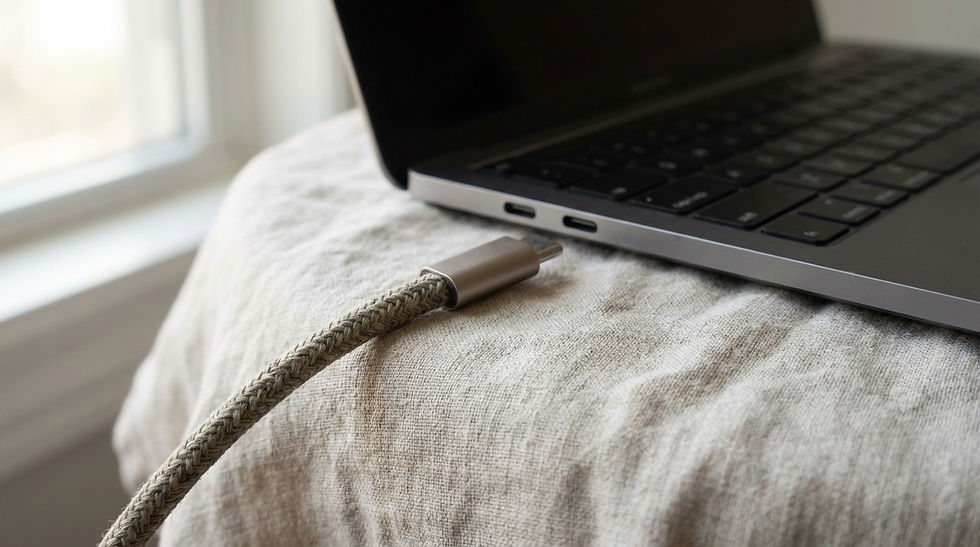
You need a physical severance ritual. When the day's output is complete, don't just put the computer to sleep and leave it on the coffee table. Shut it down completely. Close the lid. Put it inside a drawer, a heavy briefcase, or a specific closet.
Create a physical barrier that requires actual, tactile effort to breach.
Once the machine is put away, transition into the analog world. Cook a meal from a physical recipe book. Walk outside without a podcast playing. Engage with the physical weight of your life. The screen is the tool that bought your freedom; now, you actually have to go out and experience it.

Comments